

Learning
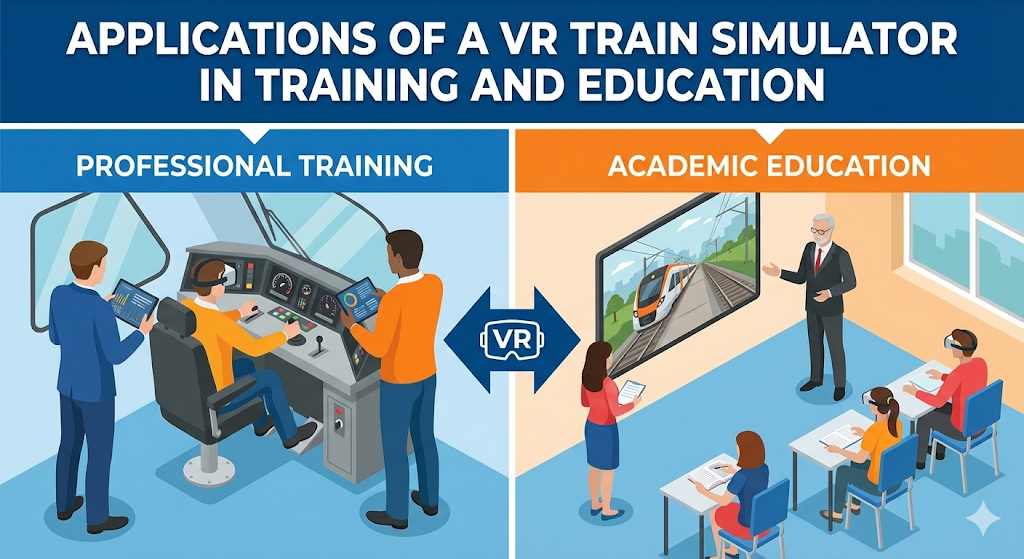
The driver and operator training is one of the most effective uses of a VR train simulator. Trainees can also practice the train operations in a virtual environment that is very realistic, without necessarily depending on classroom sessions or only using specific physical simulators.
Key advantages include:
- Going through the familiarization of routes without the actual risk.
- Controlling learning, braking, signaling.
- Traveling through various landscapes, climatic conditions, and visibility.
These simulators recreate train cabins, dashboards, and track layouts with high levels of accuracy with the assistance of a 3D visualization company.
Simulating Emergency Scenarios Safely
Real emergencies are dangerous to practice and expensive to operate in the railway; however, emergency preparedness is essential in the operations. A VR train simulator enables the trainees to be introduced to a high-risk situation with no real-world ramifications.
These simulations include:
- Signal failures
- Track obstructions
- Mechanical breakdowns
- Sudden weather disruptions
The trainees are also able to repeat the right answers, they can hit better reaction times, and have more confidence, which cannot be done using the traditional training methods.
Railway Signal and Control Staff Training
Not only are train drivers the beneficiaries. Signal operators, traffic controllers, and dispatch teams can equally use a VR train simulator.
Immersive visualization with the help of immersive visualization:
- The workflows in control rooms can be reproduced.
- The communication protocols are practical.
- Real-time decision-making is estimable.
These simulations are made close to real control systems by a specialized 3D visualization company to enhance the ability to coordinate between the various departments.
Supporting Railway Engineering and Technical Training
Academic institutions that include programs on railway engineering, transportation, or infrastructure are turning to VR-based tool usage. A VR train simulator allows the students to get a visual representation of complex systems that are not easily understood only through reading the textbooks.
The advantages of education are:
- Learning track geometry and alignment.
- Learning rolling stock mechanics
- Representation of electrical and signaling systems.
Working with a 3D visualization firm, the institutions can provide an interactive learning experience, enhancing understanding and memory.
Improving Maintenance and Safety Training
Maintenance crews are very crucial to the safety of railways. A VR train simulator will be able to simulate maintenance work and fault diagnostics without using physical equipment.
Applications include:
- Determining component wear and failures.
- Implementation of inspection routines.
- Safety measures of dangerous work.
This method will save on the training expenses and enhance accuracy and readiness in the workplace.
Standardizing Training Across Locations
The railway organisations are also known to be operating in several regions, hence a problem with standardized training. VR train simulator provides uniformity as it provides the same training modules to every location.
Benefits include:
- Uniform safety standards
- Less reliance on the physical infrastructure.
- Simple modifications to accommodate regulatory change.
Using a global-ready 3D visualisation firm, it is possible to make a simulation specific to regional regulations, tracks, and rolling stock without impacting the fundamental training standards.
Assessing Performance and Skill Progression
A VR train simulator, unlike the ancient training, gives quantifiable information on the performance of the trainee. The metrics that can be tracked by the trainers include:
- Reaction time
- Compliance with procedures
- Error frequency
These analytics assist in determining the strengths, gaps, and readiness, and making the assessment more objective and data-driven.
Encouraging Lifelong Learning and Skill Refreshers
Technology in railways is in continuous development. Training based on VR allows professionals to refresh their skills or get to know the new systems without interrupting the operations.
VR train simulator supports:
- Periodic re-certification
- New route/equipment training.
- Constant professional improvement.
It is not the same since the learning process is not tedious, as realistic environments are created by a 3D visualization company.
Preparing Students for Real-World Railway Careers
To the students, VR helps in the transition between school and work. VR train simulator introduces the learners to the challenges in the real world before joining the workforce.
This hands-on exposure:
- Builds confidence
- Improves job readiness
- Minimizes the time taken by employers to onboard.
Schools that apply hi-tech VR tools are the schools of tomorrow and are in line with the industry.
Conclusion
As a VR train simulator can be used in training and education, it can be applied in many more ways than just for training. From immersive driver training to engineering education and emergency preparedness, VR helps to make learning safer, smarter, and more effective.
These simulators are based on the experience of a 3D visualization company and provide a combination of realism, scalability, and quantifiable results, which is why they are a critical component of the contemporary railway training and education system.
